
Best Cleaning Business Management Software: Features Every Owner Should Look For
Published: November 2, 2026
Running a successful cleaning business involves much more than delivering excellent cleaning services. Between managing employees, scheduling jobs, communicating with customers, preparing estimates, and collecting payments, business owners often find themselves spending more time on administrative work than growing their companies.
As a cleaning business expands, managing everything through spreadsheets, paper calendars, text messages, and disconnected applications becomes increasingly difficult.
That’s where cleaning business management software makes a difference.
The right software can help cleaning companies streamline daily operations, improve employee accountability, automate repetitive tasks, and create a more professional customer experience.
But with so many options available, how do you determine which platform is right for your business?
In this guide, we’ll explore the essential features every cleaning business owner should look for, the benefits of adopting an all-in-one management platform, and how modern technology is changing the way cleaning companies operate.
What Is Cleaning Business Management Software?
Cleaning business management software is a digital platform designed to help residential and commercial cleaning companies organize and manage their daily operations.
Instead of relying on multiple applications for scheduling, invoicing, customer information, and employee management, business owners can bring these responsibilities together within one centralized system.
Depending on the platform, cleaning business software may include:
- Employee scheduling and job assignments
- Customer relationship management (CRM)
- Cleaning estimates and proposal generation
- Employee time tracking and GPS verification
- Automated invoicing and payment processing
- Cleaning checklists and quality assurance
- Sales pipeline and contract management
- Financial reporting and business analytics
For independent cleaners, these tools can simplify administrative responsibilities and create a more professional customer experience.
For growing cleaning companies, they provide the structure needed to manage employees, maintain service quality, and expand operations without increasing administrative workloads at the same pace.
The goal is simple: Spend less time managing the business and more time growing it.
1. Employee Scheduling and Job Management
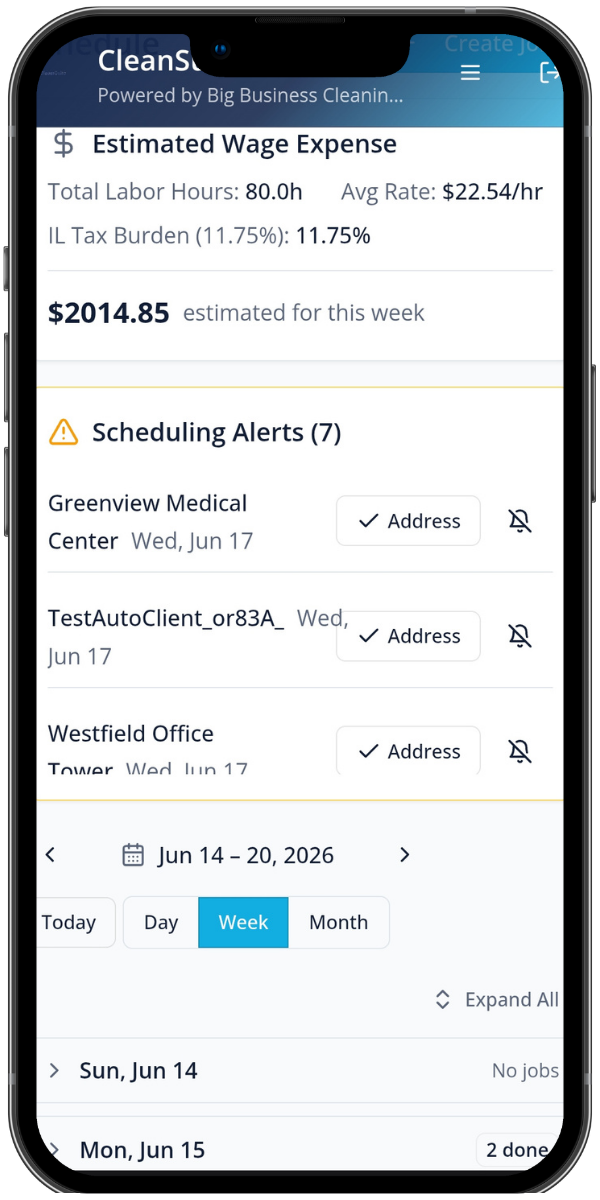
Scheduling is one of the most important responsibilities of any cleaning business owner.
As your company grows, coordinating multiple employees, customer locations, recurring appointments, and last-minute schedule changes can become complicated.
Traditional scheduling methods, such as paper calendars or spreadsheets, leave room for mistakes that can affect both employees and customers.
Why Automated Scheduling Matters
Effective cleaning business scheduling software should make it easy to organize appointments, assign employees, and maintain visibility into upcoming jobs.
Look for features such as:
- Centralized scheduling calendars
- Recurring cleaning appointments
- Employee job assignments
- Schedule updates and notifications
- Job status tracking
- Identification of scheduling gaps
Having this information in one place reduces confusion and helps business owners make better use of their available workforce.
Managing Multiple Cleaning Teams
For companies operating across several locations, scheduling becomes even more important.
Business owners need to know which employees are assigned to each job, when services are scheduled, and how assignments fit into the overall workload.
A centralized scheduling system helps prevent double bookings, reduces unnecessary communication, and keeps everyone working from the same information.
How CleanSuite Helps: CleanSuite brings scheduling and job management into one platform, helping cleaning businesses coordinate employees, recognize scheduling gaps, and manage daily operations more efficiently.
2. Customer Relationship Management (CRM)
Every successful cleaning business depends on strong customer relationships.
However, as your customer base expands, remembering individual preferences, tracking conversations, and following up on potential opportunities becomes increasingly challenging.
A built-in cleaning business CRM helps owners organize customer information and maintain consistent communication throughout the customer relationship.
Keep Customer Information Organized
A cleaning business CRM should provide a centralized location for important customer details, including:
- Contact information
- Property or service locations
- Cleaning preferences and special instructions
- Service history
- Previous estimates and contracts
- Customer communication records
- Follow-up opportunities
Having access to this information allows employees and managers to deliver more consistent service.
Turn More Leads Into Customers
Customer management shouldn’t stop once someone requests an estimate.
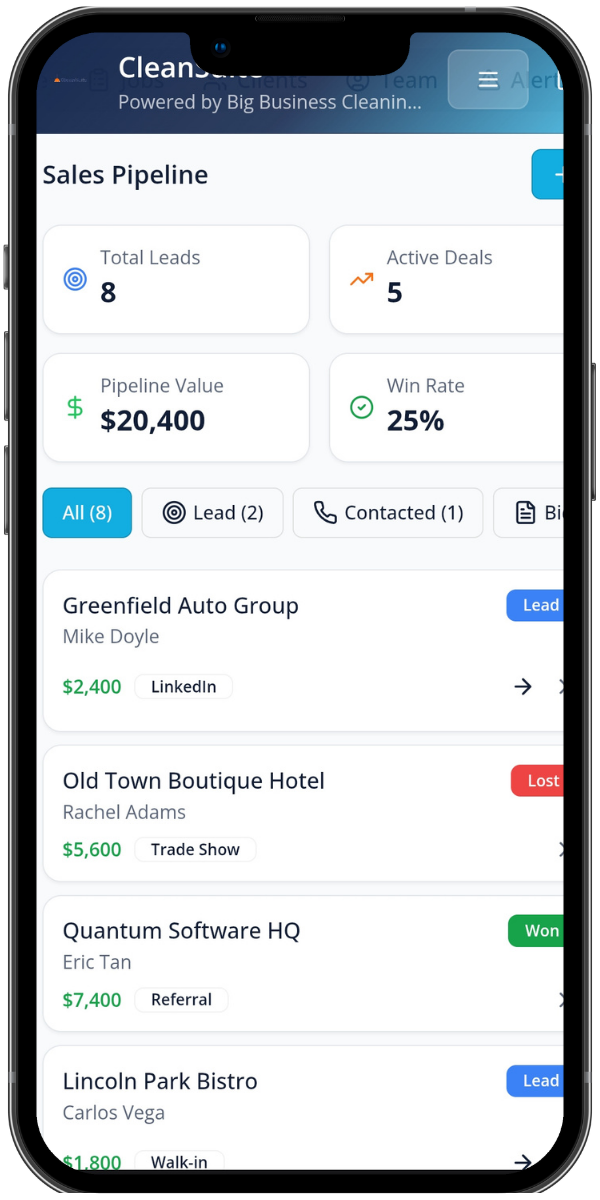
A strong CRM should also help businesses manage their sales pipeline.
For example, an owner should be able to identify which potential customers have requested quotes, which proposals are awaiting approval, and which opportunities require follow-up.
Without a structured process, valuable leads can easily get lost among emails, phone calls, and text messages.
How CleanSuite Helps: CleanSuite combines customer relationship management with a visual sales pipeline, allowing cleaning businesses to track leads, manage customer information, and move opportunities toward signed contracts.
3. Professional Estimates and Automated Bidding
Pricing cleaning services accurately is essential for protecting profitability.
Underestimating labor requirements can lead to contracts that generate little profit, while overpricing services may cause potential customers to choose a competitor.
For commercial cleaning businesses, the estimating process can become especially complex.
Factors such as building size, cleaning frequency, labor rates, payroll expenses, and production requirements all influence the final price.
What to Look for in Cleaning Estimating Software
Effective cleaning estimating software should help business owners:
- Calculate labor and operational costs
- Account for building size and service requirements
- Estimate cleaning time
- Develop consistent pricing
- Generate professional proposals
- Convert approved estimates into service agreements
Instead of starting from scratch for every potential customer, business owners can use standardized information to prepare estimates more efficiently.
Why AI-Powered Bidding Is Changing the Industry
Artificial intelligence is introducing new opportunities to simplify the estimating process.
AI-powered bidding tools can help analyze relevant job information, apply production assumptions, and generate structured proposals.
This reduces the amount of manual calculation required and allows business owners to respond to potential customers more quickly.
However, estimates should still be reviewed to ensure they reflect actual site conditions, labor requirements, and the company’s desired profit margins.
How CleanSuite Helps: CleanSuite incorporates AI-powered bidding tools designed around cleaning industry production standards, including ISSA 540, while accounting for relevant labor costs. Its proposal and contract generation capabilities help businesses move from estimating to customer agreements with less manual work.
4. GPS Employee Tracking and Time Management
One of the biggest challenges for cleaning business owners is maintaining visibility over employees working at different customer locations.
When teams operate independently, managers may struggle to confirm arrival times, track completed shifts, or accurately calculate payroll hours.
This becomes increasingly difficult as the number of employees and job sites grows.
The Benefits of GPS Tracking
Cleaning business management software with GPS tracking can provide greater visibility into field operations.
Important capabilities may include:
- GPS-verified employee clock-ins
- Geofenced job locations
- Employee arrival and departure records
- Digital timesheets
- Job activity monitoring
- Accurate labor-hour reporting
Geofencing uses location boundaries to help verify that employees are at the assigned job site when recording their time.
This creates a more reliable record of employee activity and reduces dependence on manual timesheets.
Improve Accountability Without Constant Check-Ins
GPS tracking isn’t simply about monitoring employees.
When implemented transparently and appropriately, it can help businesses establish consistent attendance procedures, resolve timekeeping questions, and reduce unnecessary communication.
Instead of calling employees throughout the day to confirm their locations, managers can review job activity from a centralized dashboard.
How CleanSuite Helps: CleanSuite includes geofenced clock-in capabilities and live activity visibility, helping owners monitor job-site attendance and manage employee time records across multiple locations.
5. Automated Invoicing and Payment Management
Getting paid on time is essential for maintaining healthy cash flow.
Unfortunately, invoicing is often one of the most time-consuming administrative responsibilities for cleaning business owners.
Manually preparing invoices, tracking outstanding balances, sending payment reminders, and reconciling customer payments can take valuable time away from daily operations.
Essential Cleaning Business Invoicing Features
Look for cleaning business invoicing software that offers:
- Professional branded invoices
- Recurring billing capabilities
- Automated invoice generation
- Online payment options
- Payment reminders
- Customer billing history
- Integration with financial management tools
These features can reduce repetitive administrative work while providing customers with a more convenient payment experience.
Why Recurring Billing Matters
Many cleaning businesses operate through weekly, biweekly, or monthly service agreements.
Recurring billing allows companies to establish consistent invoicing schedules rather than manually creating invoices after every service.
For businesses managing numerous commercial cleaning contracts, this can significantly simplify financial administration.
How CleanSuite Helps: CleanSuite connects job management with automated invoicing and recurring payment capabilities, helping business owners streamline billing and reduce the time spent managing customer payments.
6. Cleaning Checklists and Quality Assurance
Maintaining consistent service quality becomes more challenging as a cleaning business expands.
When owners personally complete every job, they can directly control the quality of their work.
However, once employees begin servicing multiple properties independently, businesses need standardized procedures to ensure customer expectations are consistently met.
Standardize Cleaning Procedures
Digital cleaning checklists help employees understand exactly what needs to be completed at each location.
These checklists can include:
- Room-specific cleaning responsibilities
- Customer-specific instructions
- Required sanitation procedures
- Task completion tracking
- Safety protocols
- Quality control requirements
Standardized checklists reduce confusion and help maintain consistency across different employees and cleaning teams.
Use Photo Verification for Added Accountability
Some cleaning management platforms allow employees to upload photos documenting completed work.
Photo verification can be particularly useful for commercial facilities, property management accounts, and customers with detailed cleaning requirements.
Managers can review completed tasks remotely instead of physically visiting every location.
Support a Multilingual Workforce
Cleaning companies frequently employ team members who speak different primary languages.
Providing instructions in employees’ preferred languages can improve understanding, reduce communication errors, and support consistent service delivery.
How CleanSuite Helps: CleanSuite combines digital task checklists, mandatory photo verification, and bilingual support to help cleaning businesses maintain quality standards across their workforce.
7. Business Automation and Administrative Efficiency
One of the biggest advantages of modern cleaning business management software is the ability to automate repetitive administrative tasks.
Many cleaning business owners spend hours each week managing activities that could be handled more efficiently through connected systems.
These responsibilities often include preparing estimates, updating schedules, creating invoices, tracking employee hours, and organizing customer information.
What Should Cleaning Businesses Automate?
Common opportunities include:
Estimate Preparation: Generate structured cleaning proposals using consistent pricing information.
Recurring Scheduling: Reduce repetitive calendar entries for customers receiving ongoing services.
Customer Follow-Ups: Keep track of prospects who have received estimates but haven’t signed contracts.
Invoice Generation: Create invoices based on completed jobs or established billing schedules.
Employee Time Tracking: Record working hours digitally to simplify payroll preparation.
Job Completion Tracking: Monitor completed assignments and identify outstanding responsibilities.
Automation helps reduce manual data entry and allows business owners to focus on customer service, employee development, and growth opportunities.
Why Connected Systems Matter
Automation becomes even more valuable when different business functions communicate with one another.
For example, when a cleaning estimate becomes an approved contract, that information can support scheduling, customer management, and future billing.
Rather than repeatedly entering the same details into separate applications, a connected platform can help information move through the business more efficiently.
How CleanSuite Helps: CleanSuite is designed to connect bidding, customer management, field operations, and financial administration within one integrated system.
8. Mobile Access for Owners and Cleaning Teams
Cleaning businesses rarely operate entirely from an office.
Owners may spend their days visiting customers, preparing estimates, supervising employees, and traveling between job sites.
Cleaning teams also need convenient access to their schedules, assignments, and instructions while working in the field.
This makes mobile accessibility an essential feature of cleaning business management software.
What Should a Cleaning Business Mobile App Include?
An effective mobile experience should allow users to:
- View upcoming assignments
- Access job details and customer instructions
- Record employee clock-ins and clock-outs
- Complete digital cleaning checklists
- Upload job verification photos
- Receive scheduling updates
- Review relevant operational information
Mobile access helps keep teams connected without relying entirely on phone calls or group text messages.
How CleanSuite Helps: CleanSuite uses a progressive web app approach, providing a mobile-friendly experience that allows cleaning teams and business owners to access operational tools while working in the field.
9. Reporting and Financial Visibility
Understanding how your cleaning business performs is just as important as delivering quality services.
Without accurate operational and financial information, business owners may struggle to identify profitable contracts, control labor expenses, or determine when they’re ready to expand.
Important Metrics to Monitor
Cleaning business owners should regularly evaluate:
- Revenue generated by customers and contracts
- Labor costs
- Estimated versus actual job hours
- Customer retention
- Outstanding invoices
- Employee productivity
- Profit margins
- Scheduling efficiency
Access to reliable information helps owners make more informed decisions about pricing, staffing, and business growth.
For example, a commercial cleaning contract may generate substantial monthly revenue but deliver disappointing profits if labor costs consistently exceed the original estimate.
Identifying these issues early provides an opportunity to adjust operations or renegotiate pricing.
How CleanSuite Helps: By bringing bidding, employee time tracking, job management, and financial workflows together, CleanSuite is designed to give cleaning business owners greater operational visibility and better information for managing profitability.
10. Scalability as Your Cleaning Business Grows
The software that works for a solo cleaning professional may not provide everything needed to manage a company with 20 employees and dozens of recurring contracts.
That’s why scalability should be an important consideration when selecting cleaning business management software.
Software for Independent Cleaning Professionals
Solo cleaners often benefit most from:
- Professional estimates
- Simple scheduling
- Customer management
- Automated invoicing
- Convenient mobile access
These features help independent operators maintain a professional image while reducing administrative work.
Software for Growing Cleaning Teams
As businesses begin hiring employees, additional priorities emerge:
- Team scheduling
- Employee accountability
- Digital cleaning checklists
- GPS time tracking
- Customer communication
- Job-site quality control
The focus shifts from managing individual jobs to coordinating people and processes.
Software for Established Cleaning Companies
Larger cleaning businesses may require more advanced capabilities, including:
- Multi-location management
- Detailed labor cost tracking
- Advanced bidding tools
- Operational reporting
- Payroll integrations
- Role-based permissions
- Centralized oversight of multiple teams
Choosing a platform that supports different stages of growth can reduce the need to repeatedly replace software as the company expands.
Introducing CleanSuite: Built Specifically for Cleaning Businesses
Cleaning businesses have operational needs that differ from those of many other service industries.
From recurring cleaning contracts and employee accountability to commercial bidding and quality verification, managing a cleaning company requires specialized tools.
CleanSuite is an all-in-one cleaning business management platform designed specifically for residential and commercial cleaning operations.
Instead of forcing cleaning companies to adapt generic business software to their workflows, CleanSuite brings essential operational tools together in one connected ecosystem.
One Platform for Your Entire Cleaning Operation
CleanSuite is designed to support the key responsibilities of running a cleaning business, including:
- AI-Powered Bidding: Create professional cleaning estimates using structured production and labor cost information.
- Customer Management: Organize customer relationships, service history, and sales opportunities.
- Employee Scheduling: Coordinate assignments and manage recurring cleaning services.
- GPS Time Tracking: Verify employee attendance using geofenced clock-ins.
- Quality Assurance: Maintain standards through digital checklists and photo verification.
- Automated Invoicing: Streamline recurring billing and customer payment workflows.
- Bilingual Team Support: Improve communication with multilingual cleaning teams.
- Mobile Accessibility: Manage essential business activities from the field.
Whether you’re an independent cleaning professional looking to become more organized or an established company managing multiple teams, CleanSuite is built to support more efficient operations and sustainable growth.
How to Choose the Right Cleaning Business Management Software
Before committing to a software platform, take time to evaluate your company’s current needs and long-term goals.
Start by identifying the administrative tasks that consume the most time.
Are you struggling to coordinate employees? Spending too many hours preparing estimates? Losing track of customer follow-ups? Having difficulty monitoring job completion?
The best software should address your most important operational challenges.
Consider these questions during your evaluation:
- Is the software designed for cleaning businesses? Industry-specific features can reduce the need for complicated workarounds.
- Does it include the tools I actually need? Prioritize scheduling, customer management, invoicing, and employee oversight.
- Can my employees use it easily? A complicated system may create more problems than it solves.
- Does it work on mobile devices? Field employees and owners need access outside the office.
- Can it grow with my company? Consider your future staffing, customer volume, and operational needs.
- Does it help reduce manual work? Look for automation that eliminates repetitive administrative responsibilities.
- Will it improve visibility into my business? Reliable records and operational information support better decision-making.
Choosing cleaning business management software should be viewed as an investment in your company’s efficiency, organization, and ability to grow.